

HOME Manchester is particularly good at programming the kind of theatre that gives you something to pick apart afterwards. Rona Munro’s IRON certainly fits into that category. Set almost entirely within the confines of a prison visiting room, it’s an intricate exploration of a fractured relationship between a mother and daughter, and everything that has been left unsaid between them.
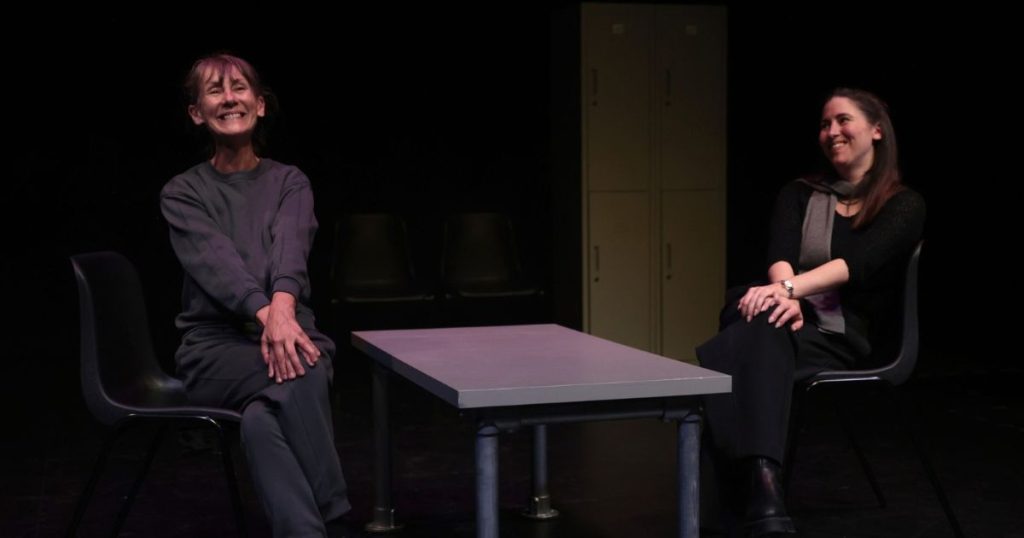
At the centre are Christine and Lois Mackie, a real-life mother and daughter portraying Fay and Josie. Fay has been in prison for 15 years, while her daughter, Josie, is visiting her for the first time after growing up disconnected from both her mother and much of what happened during her childhood.
Contents
ToggleChristine Mackie as Fay
Christine Mackie is the star of this production. Fay is fascinating because she never really seems particularly dangerous. She’s awkward, funny, and desperate to live vicariously through the experiences her daughter brings into the visiting room.
Mackie’s physicality adds much of the complexity to Fay. Her emotions are often visible before she gives them away in conversation; amusement, anxiety and hurt register through small shifts in posture, facial expression, and movement. Yet beneath those fluctuations, there is also an underlying sense of acceptance that this confined existence is simply her life now.
That resignation makes moments such as her fascination with the visiting room itself, all the more telling. It is somewhere different, somewhere she hasn’t seen in years, and that small change in environment is capable of capturing her attention. Those details give you a sense of how completely incarceration has reshaped Fay’s understanding of normality without ever needing to spell it out.
And yet, glimpses of another Fay occasionally break through.
Mackie can move between endearing, awkward, erratic, angry and quietly sinister within the same scene without any of those changes feeling forced. You sympathise with her while simultaneously wondering whether you should.
By the final scene, Mackie is genuinely haunting. A subtle shift in her facial expression and a deadpan quality behind her eyes changes the atmosphere completely. It’s eerie precisely because the production has spent so long encouraging us to connect with her.
Lois Mackie as Josie
Lois Mackie’s performance is much quieter but equally considered.
Josie initially appears cold and stern, reluctant to reveal much of herself. Gradually, however, something almost childlike begins returning to her as she builds a relationship with Fay.
The character development is fantastic to watch because it happens so gradually, revealing itself through subtle changes in her mannerisms and appearance. As Josie becomes more comfortable, a more rebellious, surprisingly innocent side begins to emerge, with her body language revealing the insecure and confused child underneath the adult exterior.
Watching that transformation happen in front of you is one of the production’s strongest elements.
Life inside the prison
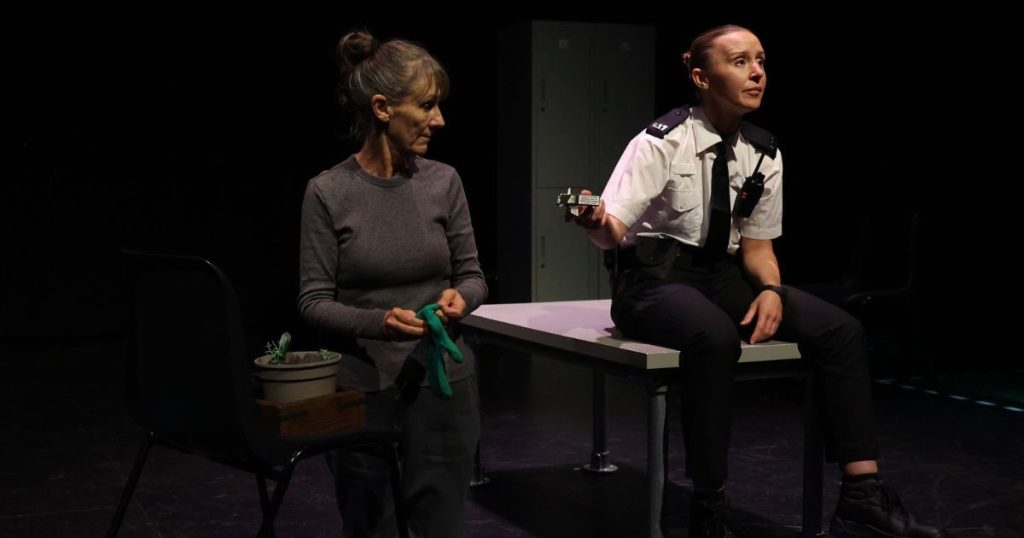
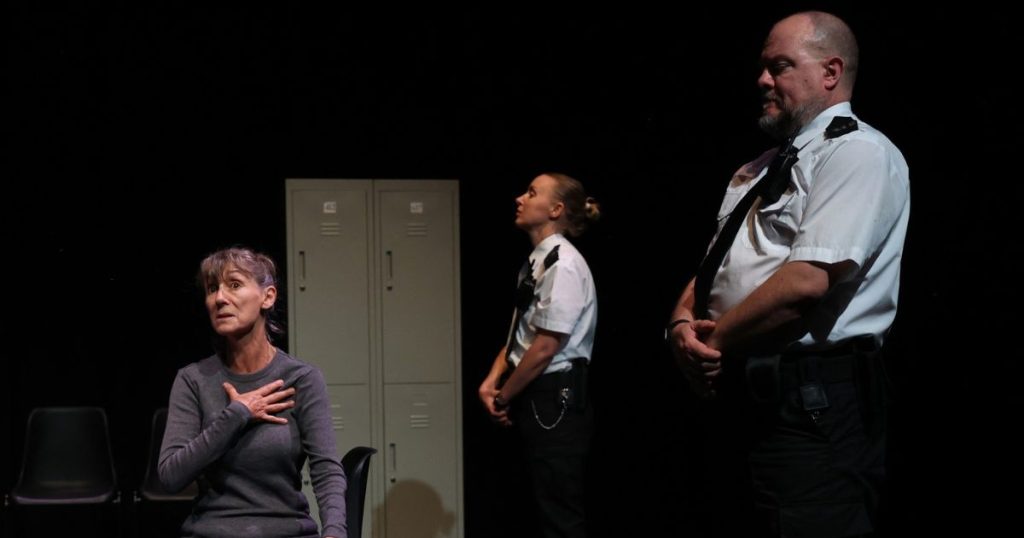
Jamie Smelt as George and Ellaney Hayden as Shiela play the two prison officers whose personalities gradually become more complicated too.
George initially appears more sensitive and understanding towards the inmates, while Shiela has more of an ‘I’ve heard it all before’ attitude. As her history with Fay becomes clearer, so does some of the hostility between them. However, neither officer remains comfortably likeable or unlikeable.
One scene might have you completely understanding their decisions. Another makes them appear cold and heartless. Smelt and Hayden handle those shifts naturally, adding another layer to a play that is constantly interested in how quickly we judge people without understanding everything that has happened behind closed doors.
When the writing works — and when it doesn't
Rona Monro’s writing is particularly effective when the production builds a world beyond what we physically see. The intimate theatre at HOME works well for the prison setting, with banging and echoes travelling through the space and creating a constant awareness of life continuing beyond the visiting room.
With minimal staging, Fay’s descriptions of her memories are vivid enough that you begin constructing those places yourself. The play understands how to make a small physical environment feel considerably larger through conversation alone.
Its exploration of female rage, trauma, motherhood and the justice system is also carefully considered. Fay presents an uncomfortable ethical dilemma because she rarely resembles the idea we might have of someone serving such a lengthy prison sentence.
But IRON is significantly longer than it needs to be.
Several conversations go backwards and forwards too many times, scenes continue beyond the point where they have made their impact, and certain ideas are explained when the audience could have been trusted to understand what was sitting underneath the dialogue.
Ironically, the desire to explore every possible angle occasionally weakens the more powerful ones. There are moments where less explanation would have given the performances more room to speak for themselves.
The performances are ultimately stronger than the script in parts, and some tighter editing could make an already uncomfortable story considerably more impactful.
Final thoughts
IRON leaves you questioning your own judgement. You spend so much time sympathising with Fay that the darker glimpses of her character become increasingly difficult to reconcile with the woman you’ve come to know. The play raises uncomfortable questions about punishment, rehabilitation and human psychology without providing an easy answer about how we are supposed to feel.
Perhaps that’s why the ending works so well. It doesn’t neatly resolve those questions. Instead, it makes you reconsider some of the assumptions you’ve already made.
Christine Mackie gives a captivating central performance, while Lois Mackie handles Josie’s gradual transformation with impressive subtlety. Alongside Jamie Smelt and Ellaney Hayden, they create four characters who repeatedly shift your perspective on who deserves your sympathy.
While the script could undoubtedly be tighter, IRON is still worth experiencing, particularly for its performances and the questions it leaves behind.
You might walk out of HOME thinking you’ve made your mind up about Fay. Then you start thinking about her again.
IRON is running at the Home Manchester until 19 September. Book your tickets now.
**Tickets gifted in exchange for an honest review
Kelsey Haslam is the founding editor of Magenta Adventures Travel Publication and a freelance travel writer with a focus on community-based travel, culture-led experiences, and theatre tourism. She is passionate about spotlighting lesser-known destinations and connecting travellers with meaningful, human-centred stories.
Her published work includes destination features and luxury hotel reviews for leading travel outlets such as A Luxury Travel Blog, Beau Monde Traveler, and Luxury Lifestyle Magazine.
Explore more about Kelsey’s background on the About Page.